At the Haridustref discussion titled “Employers’ Expectations for Vocational Education,” held on August 18 at the Estonian National Museum (ERM) in Tartu, one clear message emerged: companies do not expect vocational schools to produce ready-made specialists, but rather people with a strong foundation who are eager to learn, grow, and adapt to changing circumstances. The discussion was moderated by Eveli Kuklane, director of EWERSI.
“Everything really depends on vocational education—whether our industry will survive or not, whether we can manufacture in Estonia, and whether we are competitive,” said Raul Vene, the owner of Wermo. In his view, the future of Estonian industry is directly linked to whether vocational education can provide companies with the workers they need.
At the same time, the kind of people companies need is also changing. In today’s industry, traditional manual skills alone are no longer enough. In the woodworking industry, electronics, and other manufacturing sectors, technology, automation, robotics, and artificial intelligence are becoming increasingly intertwined. That is why companies need people who know how to work with technology and, above all, are not afraid to learn something new.
According to Hannela Viigi, a representative of Foxway, the company is looking for people who have basic skills as well as a desire to work, learn, and contribute. “We don’t want a ready-made expert who says, ‘I’ve studied this, and I know that’s how it is now,’” was stated during the discussion. For employers, discipline, teamwork and communication skills, flexibility, and a willingness to grow are at least as important.
The same idea emerged in the service sector. Henri Loodmaa, a member of the board of the Estonian Hotel and Restaurant Association and manager of restaurants in Tartu, said that the most important prerequisite is openness—a willingness to communicate, notice people, and provide them with a good experience. According to the employer, a young person fresh out of vocational school does not have to know everything right away. However, they must understand how to conduct themselves in the workplace: arrive on time, greet colleagues, be willing to learn, and be part of the team.
This is precisely where employers see an important area for improvement in vocational education. An internship should not be a mere formal addition to one’s studies, but rather an opportunity to understand, while still in school, what work actually entails. Arno Kolk, a representative of the Electronics Industry Association, highlighted the need to bring students into companies more often and to invite company representatives to speak at schools. Teachers, too, could visit companies regularly to ensure that their knowledge and understanding of the working world remain up to date.
Collaboration should begin as early as the curriculum development stage. Wermo, for example, has participated in the development of a new curriculum for wood products technology to ensure that the needs of businesses are intentionally incorporated into the curriculum, rather than depending on ad hoc collaboration.
It was also acknowledged during the discussion that the problem with vocational education is not limited to the curricula. Image is very important. Vocational schools are still too often associated with the Soviet-era perception of simple work offering few opportunities for advancement. In reality, today’s vocational education increasingly incorporates technology and engineering, and many professions offer long-term career paths.
According to employers, the relationship between vocational education and the business sector must also change. Schools shouldn’t just ask what kind of people companies need; instead, companies themselves should take more responsibility for helping young people see what a modern workplace actually looks like. Factories need to be opened up, young people need to be invited into companies, and companies need to be able to demonstrate what their work entails.
In the case of artificial intelligence, there was no perceived need to make it a separate subject. Rather, the use of AI should be an integral part of the curriculum—along with the ability to critically assess whether a machine is providing the correct answer. AI can assist with tasks, but it does not replace manual skills, problem-solving, or interpersonal communication.
Lifelong learning was also a key concept. Companies do not expect an employee to do the same job at the same machine for 40 years. Technology changes, jobs change, and people must change along with them. Therefore, vocational schools should, above all, provide a solid foundation upon which employers can build specific professional competencies.
According to employers, strengthening vocational education therefore means more than simply revamping individual curricula. What is needed is better cooperation between schools and businesses, more practical exposure to the working world, stronger instruction in general skills, and a new image for vocational education.
And, finally, a willingness to make choices. As the population of Estonia continues to decline, it doesn’t make sense to teach everything everywhere. Which fields of study we need and how many students we require must be decided in collaboration with businesses and local communities.
Perhaps the most important point raised during the Haridustref discussion was this: vocational education is not just a matter of education policy. It is a matter of Estonian industry, the service sector, and regional development. If Estonia wants to truly produce, build, repair, program, and provide services, we must have people who know how to do these things—and be prepared to continuously train more of them.
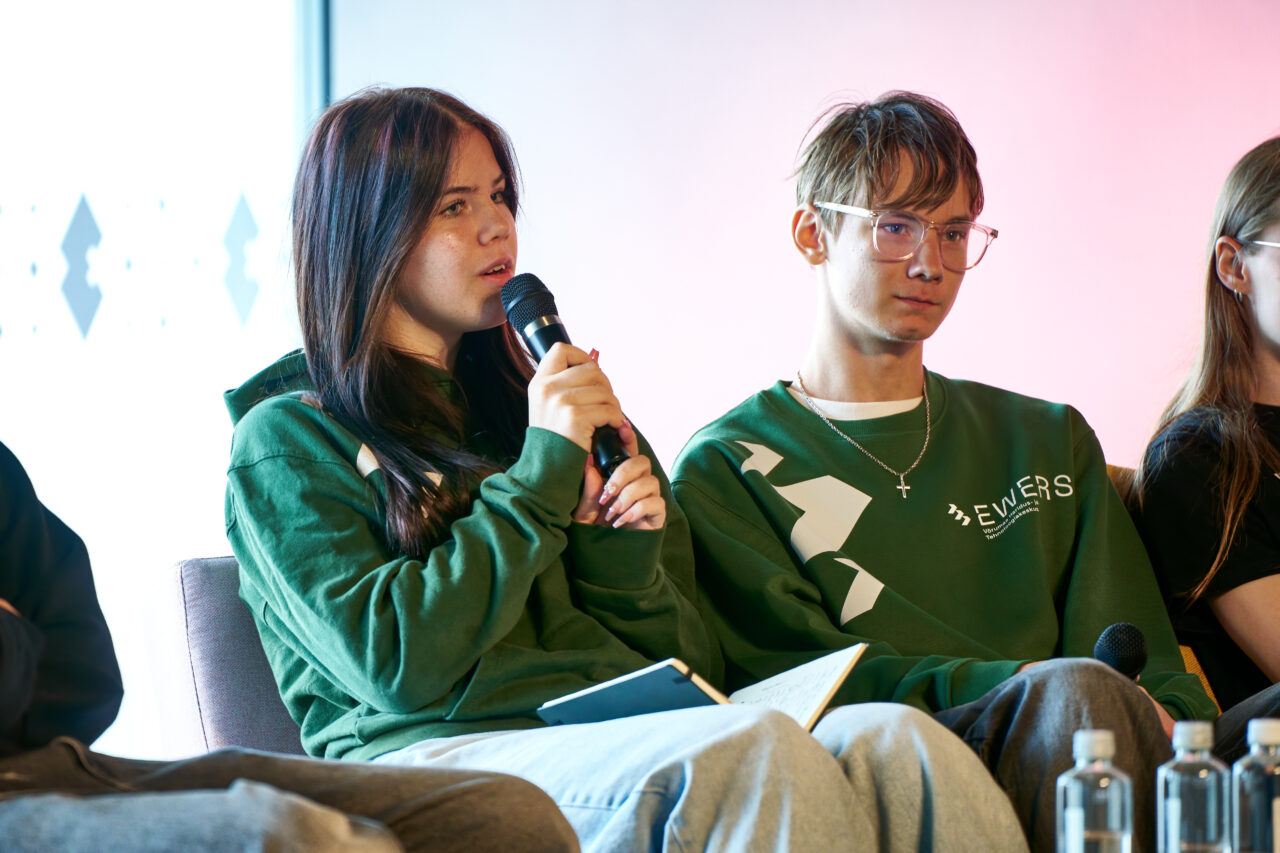
Jandra-Janette Jõela and Martin Järvelt, students at EWERS, participated in the panel discussion. Thank you!